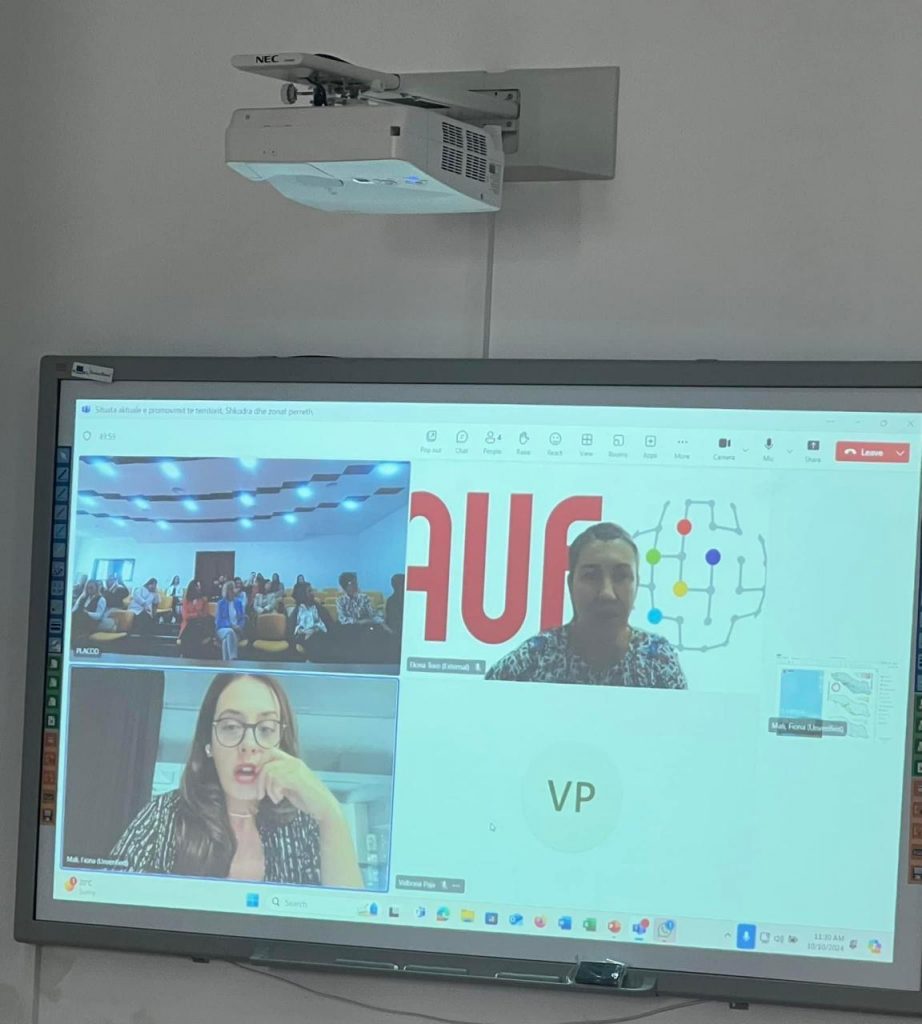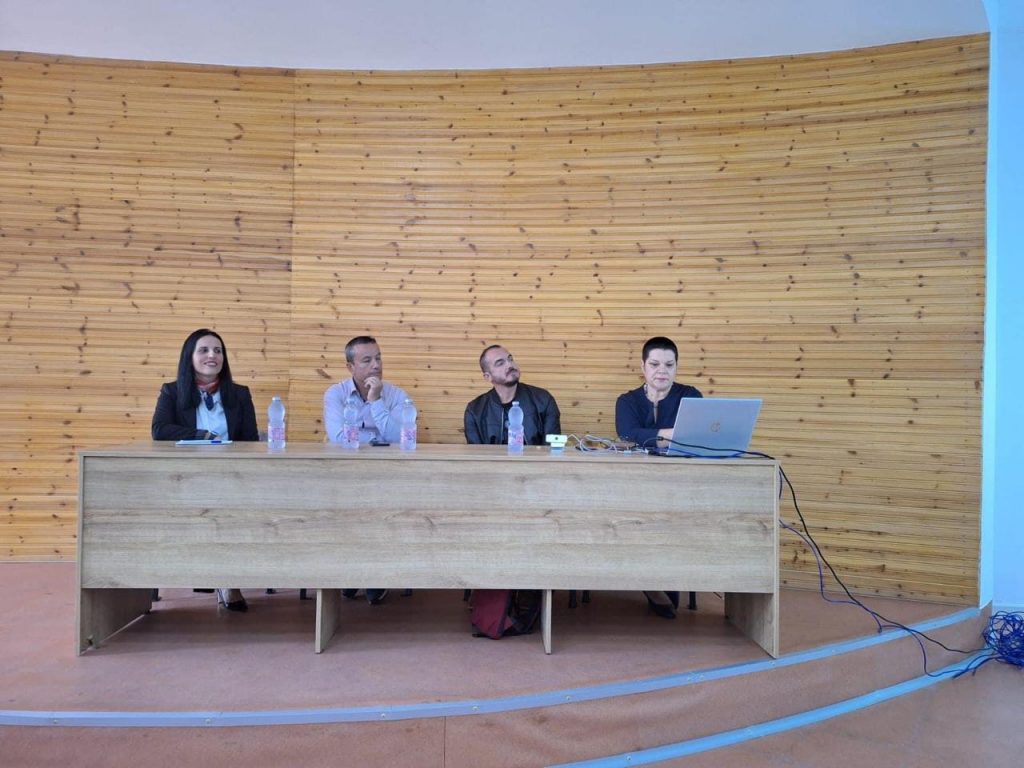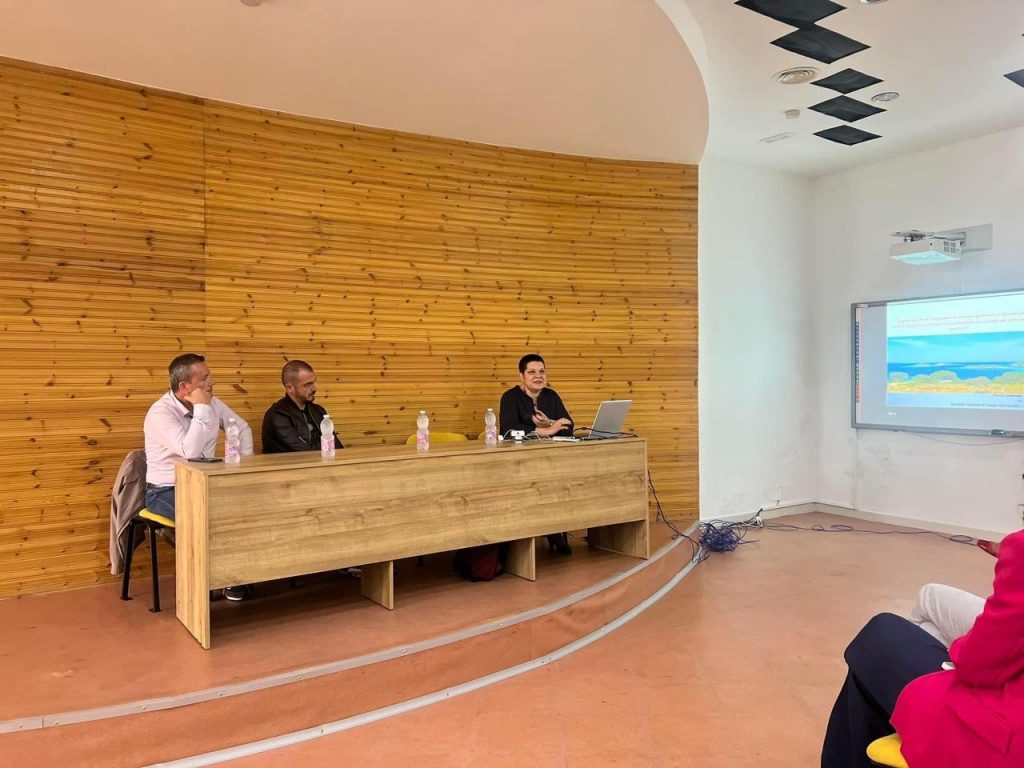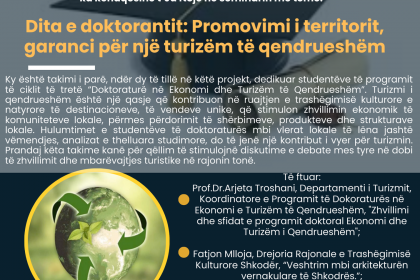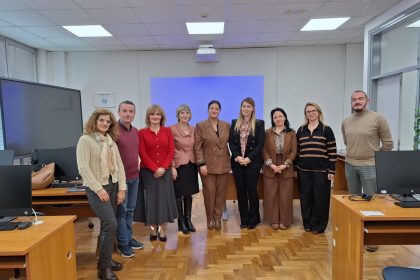
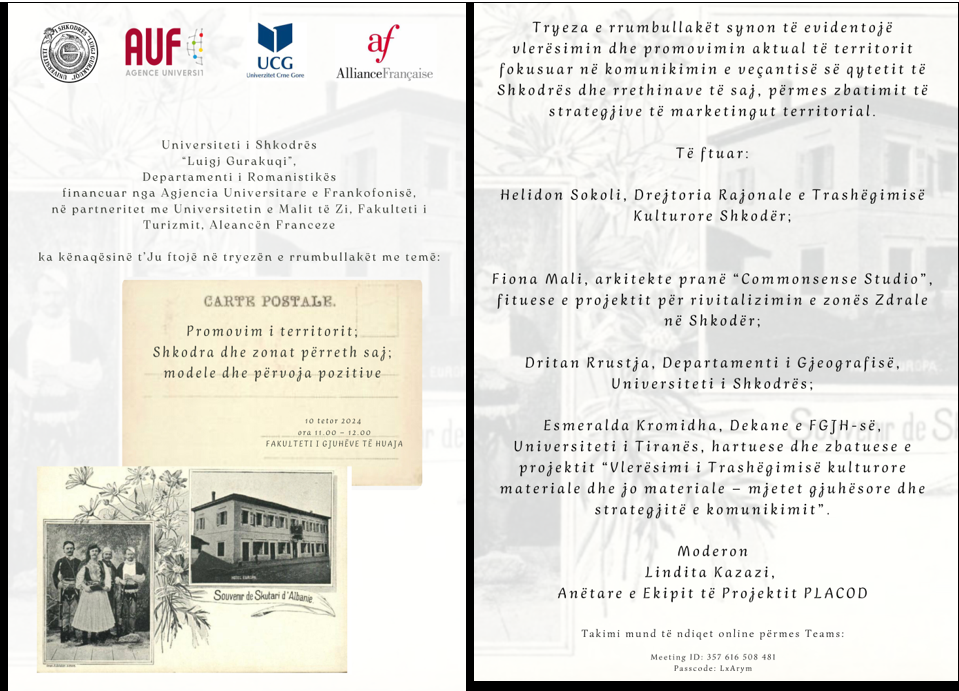
On October 10, 2024, a round table on the topic “Territory Promotion; Shkoder and its Surroundings; Positive Models and Experiences” was held at the Faculty of Foreign Languages.
The panel guests presented a general overview of the current situation of territory promotion, with an emphasis on its specificities and the territorial marketing strategies implemented to date.
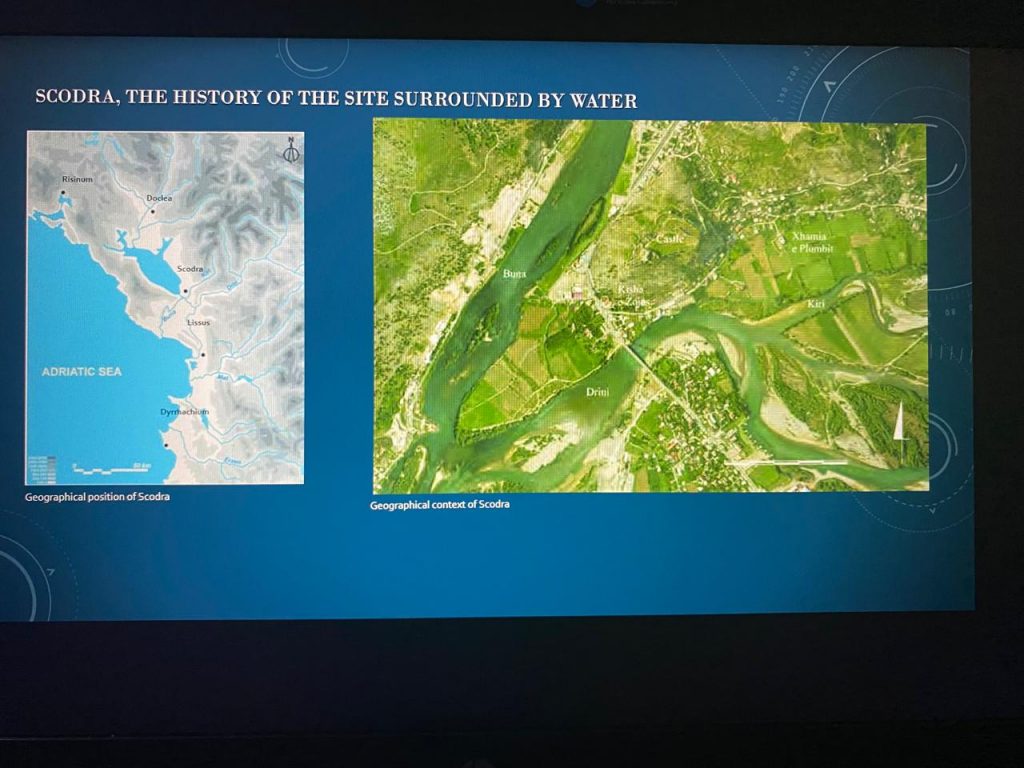
Helidon Sokoli, archaeologist at the Regional Directorate of Cultural Heritage in Shkoder, presented a visual analysis of the territorial position of Shkoder, seen from a historical perspective, showing the transformation of the territory over the centuries, the construction of the new city in the north-western part, as well as the wealth of water resources that promotes sustainable agricultural and economic development in general. Thanks to the contribution of archaeological research, intensified especially since the second half of the 20th century, Shkodër has allowed the rediscovery of its ancient city submerged by floods, as well as an entire Roman quarter on the banks of the Drin River, testified by a mosaic dating from the 3rd-4th centuries. Medieval discoveries were also made during an Albanian Polish mission between 2011 and 2017. The Plumb Mosque was restored, and a detailed image of the administrative center of the Bushatli was reconstructed. The inter-water territory extends the historical and cultural map of Shkodër beyond the current administrative borders, with the Balshaj dynasty, whose capital was Shkodër, and which financed the establishment of monasteries in the region extending between Shkodër and Montenegro. Along this territory there are 32 archaeological sites, as well as monasteries of different cults that can relate to each other by maps, bicycle or boat tours, as well as cruises between the fortifications, allowing new forms of promotion of the territory.
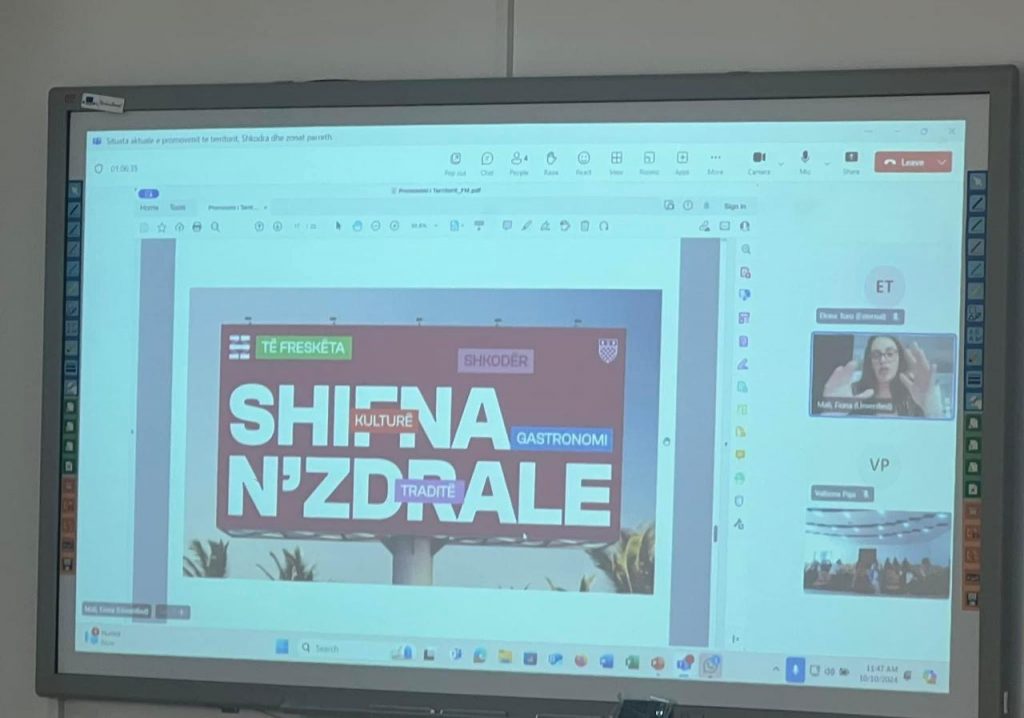
Fiona Mali, architect at “Commonsense Studio” and winner of the project for the revitalization of the Zdrale area in Shkodër, highlighted the importance given by the Municipality of Shkodër to the initiatives of 22 teams of students in architecture, economics and geography, aimed at collecting ideas for developing certain villages for tourism purposes. The information collected in previously inaccessible villages has resulted in a series of publications that allow people to get to know the city of Shkodër better. Thanks to the collaboration with the municipality for the integration of the territory, three projects were presented: a cycling route connecting the confluence of the Buna River to Lake Shkodër, the management of the Shkodër Lake Reserve, and the importance of information on cycling for ecological purposes, aimed at attracting a certain category of tourists.
Dritan Rrustja, researcher and lecturer at the Department of Geography of the University of Shkodër, as well as a licensed tourist guide, stressed the importance of guides as ambassadors of the territory, highlighting its physical, natural and human dimension. He shared his experience as a multilingual tour guide, detailing the itinerary he follows and the way he conveys general information, with a special focus on the natural, cultural, religious and linguistic diversity, as well as the country’s gastronomy and agriculture, while evoking the history of the region from a diachronic perspective.”
Esmeralda Kromidha, Dean of the Faculty of Foreign Languages at the University of Tirana, author and responsible for implementing several projects for the promotion of the territory, highlighted and briefly presented her research work carried out over two years within the framework of the project entitled “Assessment of tangible and intangible cultural heritage – linguistic tools and communication strategies”.
The panelist highlighted the essential role of language in promoting the territory as an asset for potential tourism, based on the relationship that the territory has with the community, the different actors who promote it, as well as on the way in which the process of promoting the territory takes place. She stressed the inseparable strategic pairing between tourist interest and promotion
Concerning communication strategies, including territorial communication, she specified that experts in the field, trained in linguistics, consider the value of the information to be transmitted, its typology, its scope and its uniqueness. The linguistic text plays a crucial role in attracting attention, through two elements: the corpus of tourist communication and the targeted image.
The statistics brought about the interests of foreign tourists, our expectations and the perceptions of tourists, for the period 2018-2020, testify not only to the current state of tourism, but also project its further development steps. Prof. Kromidha highlighted the fact that there are few digital platforms in foreign languages other than English.
The moderator of the round table, Dr. Lindita Kazazi, Head of the Romanistics Department, responsable of the PLACOD project, thanking the guests for the very interesting interventions, highlighted the synergy that their opinions had with the expectations of the project aimed at designing a digital platform in foreign languages (French, Italian, English, Montenegrenian, Albanian) for the promotion of the territory.